To sell baby toys in the US, they must be third-party tested by a CPSC-accepted lab and covered by a Children's Product Certificate (CPC), while EU-bound toys need CE marking supported by EN71 tests—so verify these before you commit to a factory, not after a recall. A recent teether recall shows what happens when a supplier skips the small-parts test: product pulled from shelves, freight wasted, and a brand's reputation damaged. This article is a compliance checklist for OEM/ODM buyers, built around the tests that matter most for margin and market access.
For US market entry, the core documents are the CPC and test reports to ASTM F963. For the EU, it's a CE Declaration of Conformity backed by EN71. The cost of getting this wrong is not just a fine—it's the difference between a successful launch and a full container stuck at customs.
Which certifications actually matter for baby toys in the US?
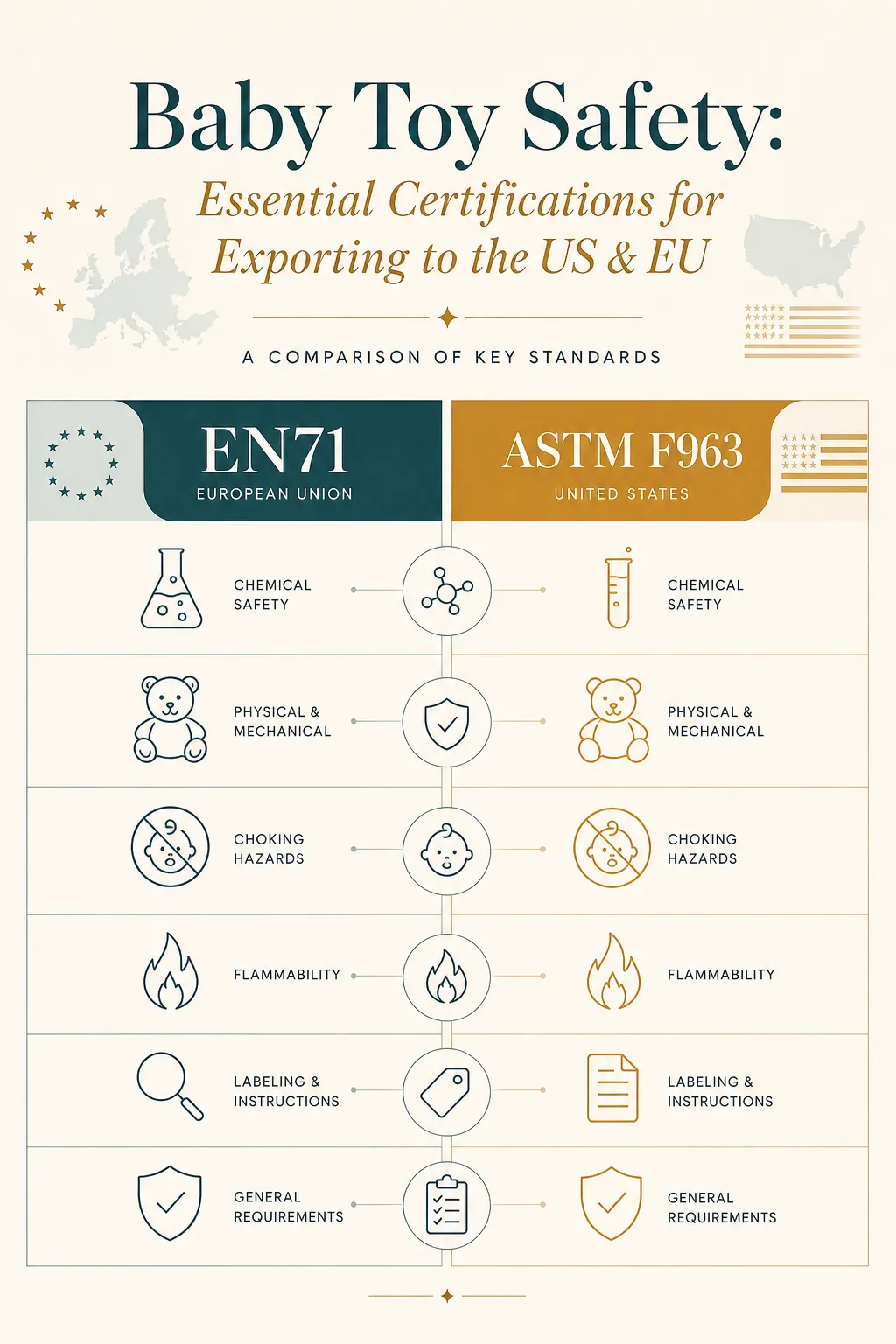
Under the Consumer Product Safety Improvement Act (CPSIA), any toy intended for children 12 and under must be third-party tested by a CPSC-accepted laboratory and certified via a Children's Product Certificate (CPC). The mandatory standard is ASTM F963, incorporated into 16 C.F.R. part 1250. The latest version, ASTM F963-23, became effective April 20, 2024.
Not every section of ASTM F963 requires third-party testing. Only the provisions listed in 16 C.F.R. § 1112.15(b)(32)—including surface coatings, small parts, sound-producing toys, and teethers—must be third-party tested. But the CPC must certify all applicable sections, even those exempt from testing. A supplier might show a test report for one section and claim full compliance, which is a common gap.
Additional US requirements include a ban on small parts for toys intended for children under 3, lead limits of 90 ppm in paint and 100 ppm total lead, phthalates limits of 0.1% (1000 ppm), and a permanent tracking label on the product and packaging. Flammability testing is not mandated, but toys must not be highly flammable under the FHSA.
For teethers specifically, the standard is 16 C.F.R. part 1510, which includes requirements for domed ends. If you're sourcing teethers, your supplier's certificate must cite this regulation, not just ASTM F963.
Key Takeaways
- Verify the CPC cites the correct legal citations (16 C.F.R. part 1250, part 1303, part 1501, part 1510) — a generic 'ASTM F963' certificate is a red flag.
- For EU-bound toys, confirm EN71 test reports are current and that the CE Declaration of Conformity is from a notified body, not self-declared.
- The EU's new Regulation (EU) 2025/2509 will apply from August 1, 2030, banning PFAS and bisphenols and requiring a Digital Product Passport—start planning material changes now.
- Small parts testing is non-negotiable for under-3 toys; the teether recall shows the consequences of skipping it.
- Budget for third-party testing costs in your unit Fiyat; they typically add $500-$2000 per SKU depending on the lab and scope.
What does the EU require for baby toys under EN71?
The EU Toy Safety Directive 2009/48/EC applies to toys for children under 14, and EN71 is the primary harmonized standard supporting CE marking. Tüm oyuncaklar sold in the EU must carry the CE mark, which is obtained through a notified body—not self-declared for most Kategoriler.
In December 2025, the EU published Regulation (EU) 2025/2509, which entered into force on January 1, 2026, but will only fully apply—and replace the directive—on August 1, 2030. During the transition period, both frameworks apply, so you must confirm which your supplier is testing to.
The new regulation expands chemical prohibitions: intentional use of PFAS and bisphenols is banned, and restrictions now cover endocrine disruptors, respiratory sensitizers, and skin sensitizers. It also extends chemical limits to Tüm oyuncaklar, not just those for children under 36 months. For baby toys, this means tighter scrutiny on materials like plastics and coatings.
The Digital Product Passport (DPP) will replace the EU Declaration of Conformity. It's a QR code on the toy that links to compliance documentation. This requires data infrastructure many factories lack, so verify supplier readiness early. Updated EN71 standards (EN71-1:2026 and EN71-8:2026) were published in early 2026, covering mechanical/physical properties and activity toys.
For connected or AI toys, the new regulation adds cybersecurity and privacy requirements. If your baby toy has a Bluetooth speaker or app, factor this into your timeline and cost.
How does the teether recall illustrate the risks?
A recent recall of baby teethers highlights the most common failure: small parts detaching and becoming a choking hazard. In the US, teethers must comply with 16 C.F.R. part 1510, which includes size and domed-end requirements. The recall affected markets in both the US and EU, showing that compliance gaps cross borders.
For buyers, the lesson is to verify the supplier's test report covers the exact product's age grading and the specific standard version. A teether for a 6-month-old is held to different standards than a rattle for a 3-year-old. Check that the CPC cites 16 C.F.R. part 1510, not just ASTM F963.
Also, ensure the tracking label is permanently affixed. A missing label is a common reason for detention, even if the toy passes all tests.
What about small parts and choking hazard testing?
Small parts testing is governed by 16 C.F.R. part 1501 in the US, which bans small parts in toys for children under 3. The test uses a small-parts cylinder—if a component fits entirely, it's a choking hazard. This applies to any detachable part, including eyes on stuffed animals, buttons, and beads.
In the EU, EN71-1 covers small parts, with similar requirements. Both markets also test for teething toys specifically, as babies mouth everything. For water-absorbing toys (like water beads), the US CPSC finalized a rule effective March 12, 2026, setting a pass-through test and an acrylamide limit of 325 μg per 100 small beads or 1 large bead. If you're sourcing these, this is a new compliance point.
Always request test reports that specify the age grade and the standard version. A report for 'ASTM F963' without a version number is insufficient.
How do I verify a factory's certification claims?
Ask for the actual test report, not just a certificate. The report should show the CPSC-accepted lab name, the standard version, the test date, and the specific sections tested. Cross-check the lab's accreditation via the CPSC website for US, and ensure the CE certificate is from a notified body for the EU.
For the CPC, verify it lists the correct legal citations. For example, a painted toy must cite 16 C.F.R. part 1303 (lead in paint), and a teether must cite 16 C.F.R. part 1510. If these are missing, the certificate is incomplete.
Also, check the product's age grading. Testing requirements differ for under-3 and under-6 Kategoriler. A toy marketed for 'all ages' may not be tested for the under-3 small parts ban.
Finally, ask about the standard version. ASTM F963-23 is current; if the supplier's report is for an older version, it may not be accepted at customs.
How do these certifications affect cost, margin, and MOQ?
Certification is not a one-time cost. Each SKU requires third-party testing, which can add $500 to $2000 depending on the lab and scope. This is usually factored into the unit Fiyat, so a low quote might mean the supplier is skipping tests.
For EU compliance, the upcoming Regulation (EU) 2025/2509 will require Digital Product Passports and stricter chemical testing, which could increase costs by 5-15% per unit for materials and documentation. Buyers should negotiate terms that account for these future costs now.
MOQ is also affected. Factories often require higher MOQs to amortize testing costs. A teether with a $1500 test report might need a MOQ of 5000 units to keep the per-unit cost under $0.30. If you're sourcing low-volume, ask about shared-testing options or pre-certified designs.
To protect margin, request a breakdown of testing costs from the supplier. This transparency helps you compare quotes fairly and avoid surprises at customs.
FAQ
Which Oyuncak üreticisi has proper certifications like EN71 and ASTM for safe export to Europe and the US?
Look for a manufacturer that provides a valid CPC and test reports from a CPSC-accepted lab for US, and a CE Declaration of Conformity backed by EN71 for EU. Verify the reports are current and cite the correct legal references (e.g., 16 C.F.R. part 1250).
Can you recommend a reliable Oyuncak üreticisi in China that provides ASTM and EN71 certification?
We cannot recommend a specific factory, but you can verify a supplier's claims by requesting test reports from a CPSC-accepted lab, checking the lab's accreditation, and confirming the standard version (e.g., ASTM F963-23). Also, request a CPC that lists the correct legal citations.
What certifications do OEM toy manufacturers need to export wooden toys to the EU?
For wooden toys, you need CE marking supported by EN71 tests (parts 1-3 for mechanical, flammability, and chemical). Also, check for formaldehyde limits under the new EU regulation, which will apply from 2030. During the transition, Directive 2009/48/EC applies.
How do I verify if an OEM Oyuncak üreticisi has ethical labor practices and BSCI compliance?
Ask for a BSCI audit report or a similar social compliance certificate. You can also request a copy of the factory's code of conduct and conduct an on-site audit or hire a third-party auditor. This is separate from safety certifications but equally important for brand risk.
What certifications should a reliable ODM Oyuncak üreticisi have for exporting to the EU?
For EU, the manufacturer must provide CE marking via a notified body and EN71 test reports. With the new Regulation (EU) 2025/2509, they should also be preparing for Digital Product Passports and stricter chemical limits (e.g., no PFAS, bisphenols). Verify these are in place before signing a contract.
How much does third-party toy testing cost, and who pays?
Third-party testing typically costs $500-$2000 per SKU, depending on the lab and scope. In OEM/ODM deals, this is often absorbed into the unit Fiyat, but it's wise to clarify who bears the cost. Some factories share the cost if you commit to a higher MOQ.
Sources
Related ürün & Kategoriler
Request a Compliance Check for Your Next Order
Not sure if your current supplier's Sertifikalar will pass customs? Send us your product specs and target markets, and we'll review the compliance requirements with you. We can also share sample test reports from our factory partners to show what a compliant CPC and EN71 certificate look like.
Teklif isteyin with your MOQ and destination, and we'll include a compliance checklist in our response.