
The most important decision you will make when sourcing OEM electric universal crab toys is not the price per unit, but whether your supplier builds the battery compartment with a screw-secured lid and uses certified electronic components. A 5-cent savings on a battery door is the single biggest predictor of a recall on Amazon or a shelf pull in the EU. This page maps out exactly how to find, vet, and qualify factories for interactive animal toys with light and sound—using the electric universal crab as the concrete worked example. We cover the three mandatory certifications (EN71, ASTM F963, FCC), the material specification that matters (ABS versus alternatives), realistic MOQ bands for private-label orders, tooling costs for custom shell molds, and a step-by-step audit checklist for electronic component sourcing. The sourcing rules below will keep your shipment out of customs hold and your return rate below 2%.
What Is an Electric Universal Crab Toy & Why Stock It?
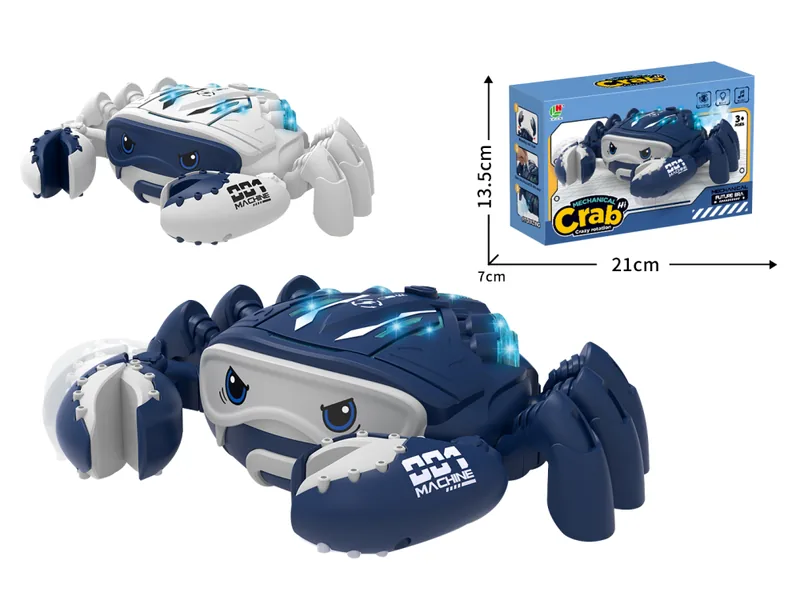
An electric universal crab is a motorized, sculpted crustacean—usually in red ABS—that scuttles sideways, flashes multicolor LEDs, and plays sound effects. The "universal" in the name signals omnidirectional obstacle-avoidance sensors: when the crab bumps into a wall or a child's hand, it reverses and turns. This autonomous movement is the core novelty that makes it a repeat seller in the 2-8 age bracket.
Three forces are pushing this SKU into distributor catalogues right now. First, the "sensory toy" category—toys that combine motion, light, and sound—is growing at roughly 9% annually in North America and Western Europe, driven by parent demand for non-screen entertainment. Second, crab toys photograph extremely well for social video; a scuttling crab on a kitchen floor routinely generates millions of views, which translates directly into Amazon search volume spikes. Third, the bill of materials is relatively simple (ABS shell, micro-motor, LED board, speaker, battery contacts, screws), which keeps FOB prices in a band where landed cost still leaves 55-65% gross margin at a $14.99 retail price point.
The B2B import case is straightforward: this is a low-cost, high-perceived-value impulse item that works across dollar stores, gift shops, beach-town souvenir outlets, and online marketplaces. Because the mechanism is platform-agnostic—it runs on three AA batteries and requires no app—it sidesteps the Bluetooth/FCC complexity that slows down other electronic toys.
For the importer who wants to own the SKU rather than resell a generic, OEM customization opens up differentiation on shell color, sound chip content (custom voice lines, branded jingles), and packaging. Those are the variables that determine whether you are competing solely on price or building a defensible brand.
What Are the Real Margin Advantages of OEM Crab Toys vs. Off-the-Shelf?
Wholesale OEM purchasing on this category delivers four specific margin and moat advantages that off-the-shelf buying cannot match.
First, custom shell color and packaging let you own the listing. When every Amazon seller pulls from the same red-crab public mold, the buy box becomes a race to the bottom. Commissioning your own ABS color masterbatch (minimum 25 kg at most compounders, cost roughly $200-$400) and a custom color-printed box creates a unique ASIN that is harder for competitors to hijack.
Second, you control the battery compartment design. Public-mold crabs occasionally ship with a simple snap-fit battery lid—a violation of both EN71-1 clause 4.21 (small parts accessible without tool) and ASTM F963 section 4.25. Specifying a screw-secured battery door in your OEM brief eliminates the single most common compliance failure on this product.
Third, you can pre-load your own sound chip. The generic IC plays a handful of tinny chirps. An OEM order lets you flash custom audio—a brand jingle, a "hello" in the local language, or a recognizable character sound—which boosts perceived value without adding meaningful BOM cost (typically $0.08-$0.15 per chip for a one-time programming fee of $80-$150).
Fourth, you lock in component traceability. When you buy generic stock, you inherit whatever motor and LED supplier the factory used that week. An OEM contract with a bill-of-materials annex forces the factory to declare electronic component sources, making it possible to audit for RoHS compliance and consistency—a safeguard that generic buyers skip and later regret.
Which Interactive Light & Sound Animal Toys Should I Source Alongside the Crab?
While the electric universal crab is the anchor SKU for this guide, importers who build a broader interactive animal assortment see higher average order values and better container utilization. Below are three product archetypes that share the same core supply chain (ABS molding, micro-motors, simple PCB design) and certification requirements, making them natural add-ons to a crab-focused purchase order.
First, the electric dancing squid. This toy uses a similar motor-and-gear assembly to produce a wiggling, sliding motion, with LED eyes and a laugh track. It targets the same 3-6 age range and fits the same FOB price band as the crab. Because the squid body is a simpler extrusion shape, mold costs for a custom shell are typically 15-20% lower than for the crab's articulated legs. Stock-mold MOQ starts at 120 units with an FOB price around $4.65.
Second, the electric musical dinosaur catapult fishing tray—a hybrid play set that combines a motorized dinosaur figure with a magnetic fishing game and a catapult launcher. This SKU carries a higher perceived value and supports a $19.99+ retail price. The multi-function format also makes it more defensible against commoditization, since cloning the full tray assembly is harder than copying a single motorized figure. Stock-mold MOQ starts at 96 units with an FOB price around $4.03.
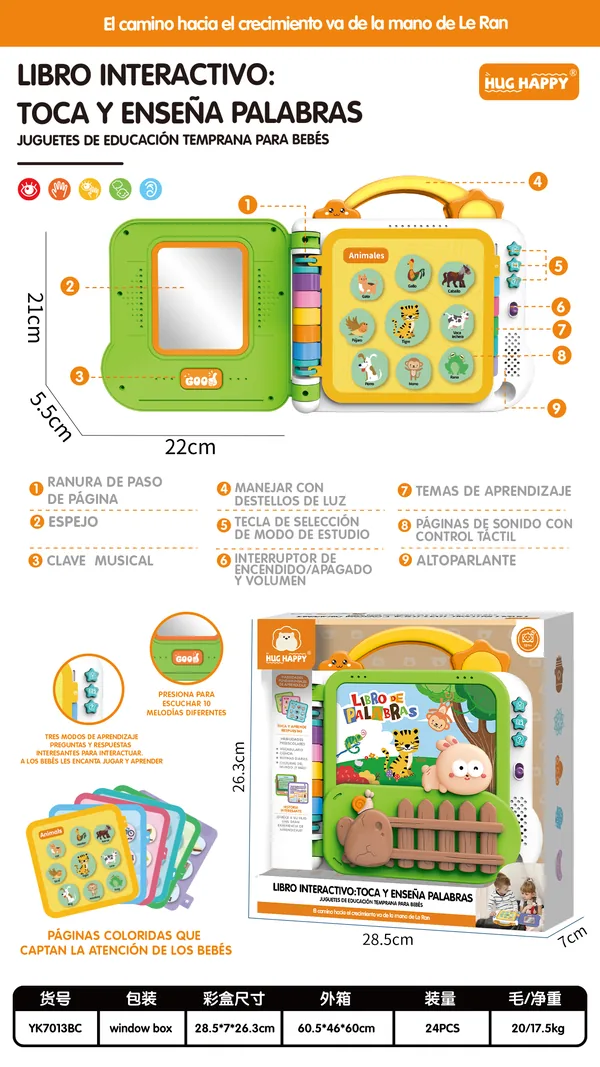
Third, the early educational electric story book. Though not an animal toy, it shares the same ABS housing, speaker module, and PCB supply base. For importers serving the Spanish-language market, a Spanish-voice story book is a high-margin differentiator, especially in the US Hispanic retail channel and Latin American distribution. Stock-mold MOQ starts at 48 units with an FOB price around $6.68.
Interactive Toy Picks Overview
| Product | Electric Universal Crab with Light & Sound | Electric Dancing Squid | Musical Dinosaur Catapult Fishing Tray | Early Educational Story Book (Spanish) |
|---|---|
| Key Selling Point | Omnidirectional obstacle avoidance; high social-media virality | Wiggling motion + LED eyes; lower mold cost than crab | Multi-function play set; higher perceived value, harder to clone | Spanish-language audio; strong US Hispanic & LatAm demand |
| Typical OEM MOQ | 1,000-3,000 pcs (custom mold); 360 pcs (stock private label) | 1,000-3,000 pcs (custom mold); 120 pcs (stock) | 1,000-3,000 pcs (custom mold); 96 pcs (stock) | 1,000-3,000 pcs (custom); 48 pcs (stock) |
| FOB Price (Stock MOQ) | ~$2.30/unit at 360 pcs | ~$4.65/unit at 120 pcs | ~$4.03/unit at 96 pcs | ~$6.68/unit at 48 pcs |
| Best-Fit Channel | Amazon FBA, beach shops, dollar stores, gift shops | Amazon, novelty stores, carnival supply | Specialty toy stores, mid-tier retail, online brand stores | Bookstores, educational supply, US Hispanic retailers, LatAm distribution |
| Mandatory Certifications | EN71-1/2/3, ASTM F963, FCC (electronics) | EN71, ASTM F963, EN62115, UKCA, CCPSA | EN71, ASTM F963, CPC, PAHS, 10P | EN71, ASTM F963, CPSIA, CPC, CE, EMC, RoHS |
Step-by-Step: How to Source OEM Electric Crab Toys with Full Compliance
The sourcing sequence below is built from real-world product recalls and compliance failures. Each step addresses a decision point where importers either build a safe, defensible product or cut a corner that boomerangs later.
Step 1: Define Your Material and Battery Compartment Spec Before Contacting Factories
Start with a one-page spec sheet, not an email that says "I want a crab toy." The spec must lock two things: shell material and battery door mechanism.
The shell should be virgin ABS, not recycled ABS or polystyrene. Recycled ABS is cheaper but brittle; it cracks at the leg joints after 20-30 flex cycles. Polystyrene is even cheaper but shatters on impact—a guaranteed safety-test failure. Specify ABS with UV stabilizer if the crab will sit in beach-shop windows. The cost difference between virgin ABS and recycled is roughly 8-12% on the raw material, or about $0.06-$0.10 per unit—trivial next to the cost of a recall.
The battery compartment must be secured with a screw, not a snap-fit latch. Both EN71-1 and ASTM F963 require that batteries be inaccessible to a child without the use of a tool. A snap-fit lid that a three-year-old can pry open with a fingernail fails this test. Write into your spec: "Battery compartment lid secured by a single M2.5 Phillips-head screw, captive (non-removable when loosened)." The screw itself costs under a penny; retrofitting a mold after the fact costs thousands.
Step 2: Map the Certification Trifecta—EN71, ASTM F963, and FCC
An electric crab toy is both a toy and an electronic device, which means it falls under two regulatory regimes simultaneously. Missing either one will block the shipment at the port of entry.
For the EU and UK market, you need EN71 Parts 1, 2, and 3 (mechanical/physical properties, flammability, migration of certain elements) plus CE marking. For electronics specifically, EN62115 (electric toy safety) applies. For the US, you need ASTM F963 (the toy safety standard) and CPSIA compliance (lead content, phthalates, tracking label). Separately, the FCC Part 15 certification covers the intentional radiator—the LED driver and sound board emit electromagnetic energy that falls under FCC jurisdiction. Many first-time importers discover the FCC requirement only when their shipment is flagged by US Customs.
Do not accept a factory's verbal assurance of "we have certificates." Request the actual test reports from an ISO 17025-accredited lab (SGS, Intertek, TÜV, or Bureau Veritas), check the report date (certifications on electronic toys should be renewed every 12-24 months because component batches change), and verify that the report covers the exact SKU with the motor and LED board you are buying—not a similar model from three years ago.
The detection cost for all three certifications on a new OEM SKU typically runs $1,500-$3,000, paid by the buyer. Build this into your landed-cost model upfront. Factories that quote "free testing" are either burying the cost in a higher unit price or submitting to a non-accredited lab whose reports customs will reject.
Step 3: Audit Electronic Component Sourcing—The Recall Hotspot
More crab toy recalls trace back to the electronics supply chain than to the plastic shell. The motor, LED board, speaker, and battery contacts are the components most likely to contain non-compliant solder (lead exceeding RoHS limits), substandard wiring (insufficient gauge for current draw, causing overheating), or untested lithium coin cells if the toy uses a demo battery.
Before placing a deposit, ask the factory for a component supplier list covering at least the motor, PCB assembly house, speaker, and battery contact manufacturer. A factory that cannot or will not provide this list is almost certainly sourcing from a spot market where component batches change weekly and traceability is zero. Then request the RoHS test reports for each electronic subcomponent—not just the finished toy. A responsible factory keeps these on file from their component vendors; an irresponsible one will tell you "the finished product certificate covers everything" (it doesn't, because RoHS compliance on a subcomponent like the motor's internal solder joints is not tested during a whole-toy EN71 migration-of-elements assay).
If you cannot visit the factory in person, commission a third-party audit through an inspection firm (SGS, QIMA, or AsiaInspection) with a specific scope-of-work that includes: "Verify electronic component incoming quality control records for the last three production batches. Photograph component storage conditions. Collect solder samples for XRF lead screening." This audit costs $400-$800 and takes one day.
Step 4: Understand MOQ, Tooling Costs, and the Private-Label Middle Path
OEM crab toys sit in three MOQ bands, and picking the wrong one for your stage of business is a common and expensive mistake.
Full custom mold OEM: MOQ 1,000-3,000 units. The factory opens a new injection mold for your proprietary shell shape. Tooling cost for a crab toy with articulated legs (4-6 mold cavities) runs $3,000-$8,000 depending on cavity count and steel grade. This path makes sense if you are ordering 5,000+ units per year and want a unique shape that no competitor can copy. It is the wrong path if you are testing a new brand and ordering 500 units—the mold amortization per unit will destroy your margin.
Stock mold private label: MOQ 360-500 units. You use the factory's existing public mold but specify your own color, sound chip content, and packaging. No tooling cost. FOB Shantou for a stock-mold crab with custom color and packaging at this MOQ band typically runs $2.00-$3.50 per unit. This is the sweet spot for first-time importers and Amazon brand builders who want differentiation without the mold investment. The trade-off is that the shell shape is not exclusive; competitors can buy the same shape in a different color.
Off-the-shelf wholesale: MOQ as low as 36-60 units for stock inventory. You buy the factory's generic red crab in the factory's generic box. Lowest risk, lowest margin, fastest speed to market. Useful for filling a container with variety or testing a new sales channel before committing to OEM.
Key Sourcing Rules for Electric Crab Toys
- Spec virgin ABS, not recycled or polystyrene. The $0.06-$0.10 per-unit savings on recycled material is not worth the recall risk from brittle leg joints.
- Require a screw-secured battery door (M2.5 Phillips-head, captive). A snap-fit lid fails EN71-1 and ASTM F963 and is the #1 cause of crab toy recalls.
- Demand EN71, ASTM F963, and FCC test reports from an ISO 17025-accredited lab (SGS, Intertek, TÜV, Bureau Veritas) dated within 18 months. Budget $1,500-$3,000 for certification testing on a new OEM SKU.
- Audit the electronic component supply chain. Request a supplier list for the motor, PCB, speaker, and battery contacts, plus subcomponent RoHS reports. A $400-$800 third-party audit with XRF solder screening is the highest-ROI quality spend on this product.
- Start with stock-mold private label (MOQ 360-500 units, no tooling cost) unless you have 5,000+ unit annual volume to justify a $3,000-$8,000 custom mold.
What to Ask Suppliers Before You Commit
The RFQ for an electric crab toy is more technical than for a plush or a wooden toy. The questions below are designed to surface the compliance and quality risks that generic price quotes hide. Send these in your initial inquiry email; factories that answer all of them clearly within 48 hours are worth shortlisting. Factories that dodge the electronics questions are signaling that they cannot control their component supply chain.
| Material specification | Confirm the shell is virgin ABS. Ask for the resin supplier name and grade. Recycled or blended ABS is not acceptable. Request a material data sheet. |
|---|---|
| Battery compartment design | Is the battery door secured with a screw or a snap-fit latch? If screw, provide the screw specification (M2.5 Phillips-head, captive). If snap-fit, confirm you can modify it to screw-secured as part of OEM. |
| Electronic component traceability | Provide the supplier names for the micro-motor, PCB assembly, speaker, and battery contacts. Attach the most recent RoHS test reports for each subcomponent. |
| Certification status | Attach current EN71-1/2/3, ASTM F963, and FCC Part 15 test reports for the crab SKU. Confirm the issuing lab is ISO 17025-accredited and the report date is within 18 months. |
| MOQ, tooling cost, and lead time | Quote MOQ for (a) stock-mold private label with custom color/packaging, and (b) full custom mold OEM. Include tooling cost, mold cavity count, and production lead time after sample approval. |
| Sample policy | Cost of an existing stock sample including courier to [your city]? Is the sample cost deductible from the bulk order? How long to produce a custom pre-production sample? |
| Sound chip customization | Can you program a custom audio file onto the sound chip? What is the one-time programming fee and the per-unit cost adder? What audio format do you require (.wav, .mp3)? |
FAQ: Sourcing OEM Electric Crab Toys
What is the minimum MOQ for a custom-mold OEM electric crab toy?
Full custom mold OEM typically requires 1,000 to 3,000 units, with tooling costs of $3,000 to $8,000 depending on mold complexity and cavity count. Stock-mold private label with your own color and packaging can start at 360 units with no tooling fee.
Which certifications are mandatory for importing electric crab toys into the US and EU?
For the EU: EN71 Parts 1/2/3, CE, and EN62115 (electric toy safety). For the US: ASTM F963, CPSIA compliance, and FCC Part 15 for the electronic components. Always request test reports from an ISO 17025-accredited lab (SGS, Intertek, TÜV, or Bureau Veritas) dated within 18 months.
Why does the battery compartment need a screw?
Both EN71-1 clause 4.21 and ASTM F963 section 4.25 require that batteries be inaccessible to children without a tool. A snap-fit lid that can be opened by hand fails compliance testing and is the most common cause of recall for this product category.
How do I audit a factory's electronic component quality?
Request a component supplier list for the motor, PCB, speaker, and battery contacts. Ask for subcomponent RoHS reports. Commission a third-party audit (SGS, QIMA, or AsiaInspection) with a specific scope to verify incoming QC records and conduct XRF lead screening on solder samples. Cost: $400-$800.
Can I customize the sound effects on an OEM crab toy?
Yes. Most factories can flash a custom audio file onto the sound chip. Expect a one-time programming fee of $80-$150 and a per-unit cost adder of $0.08-$0.15. Submit your audio in .wav format and specify the desired playback trigger.
What is a realistic FOB price for a stock-mold private-label electric crab?
For a stock-mold crab with custom color and packaging at MOQ 360-500 units, FOB Shantou prices typically range from $2.00 to $3.50 per unit depending on component quality, certification scope, and packaging complexity. Full custom-mold orders amortize tooling over larger volumes.
Related Products & Categories
Request a Quote for Your OEM Crab Toy Project
If you are ready to move from research to RFQ, TopToyFactory can provide a detailed quotation for stock-mold private-label or full custom-mold electric crab toys. Our team works with virgin ABS, screw-secured battery compartments, and EN71/ASTM/FCC-certified electronic components as standard—not as an upsell. Send us your spec sheet or use our RFQ template above, and we will return a quote with MOQ, tooling cost (if applicable), certification documentation, and lead time within 48 hours. For a closer look at our stock crab model before customization, visit the Electric Universal Crab with Light & Sound product page.