
A toy for a child under 3 fails safety compliance if any component detaches and fits entirely inside a 31.7mm-diameter small parts cylinder, if any accessible edge has a radius under 2mm, or if any cord stretches beyond 22cm. These three structural rules determine whether your shipment clears customs or triggers a recall that erases your margin on the entire container. This each requirement into inspection steps you can execute during a factory visit, explains how to read a test report without an engineering background, and maps the cost-compliance trade-offs that shape your MOQ and unit price before you issue a PO.
Key Takeaways
- Small parts rule: any component that fits entirely inside a 31.7mm-diameter small parts cylinder without compression is a banned small part for under-3 toys — including pieces that break off during use-and-abuse testing.
- Edge safety demands a minimum 2mm radius on all accessible edges. In practice, this means no sharp flashes, burrs, or knife-edged parting lines left from the injection molding or trimming process.
- Cords, strings, and elastics on under-3 toys must not exceed 22cm in length when stretched taut. Longer cords create a strangulation hazard that customs labs flag immediately.
- Factory-direct pricing from China often drops 20-40% versus domestic wholesalers, but the cost of a failed third-party lab test — rework, shipping delays, lost retail slots — can exceed that savings by 10x.
- Reputable suppliers will proactively provide an EN71-1 or ASTM F963 test report for the exact SKU you're ordering. A supplier who hesitates or offers only a 'similar product' report is a red flag.
Inspection Methods Compared: Cost vs. Certainty
| Step | What to check |
|---|---|
| In-house visual & tactile check | Run fingers along all parting lines and edges. Drop the toy from 1m onto concrete and inspect for detached fragments. Pull cords to full extension and measure. |
| Factory-supplied test report audit | Match the report's SKU, batch number, and date to your PO. Confirm the lab is ISO 17025 accredited. Verify small parts cylinder, sharp edge, and cord length results are explicitly stated. |
| Third-party pre-shipment inspection (PSI) | Hire an inspection firm (e.g., QIMA, Bureau Veritas) to perform on-site mechanical testing of a statistically valid sample from your actual production run before container loading. |
| Independent lab certification (full compliance) | Submit production samples to an accredited lab for full ASTM F963 or EN71-1 testing against sections 4.6 (small parts), 4.7 (sharp edges), and 4.14 (cords). This is the strongest documentation for retailer compliance. |
What Are the Three Safety Rules That Determine My Unit Cost?
Every under-3 toy sits at the intersection of three structural rules. Understanding each one from a manufacturing perspective reveals exactly where your unit cost comes from — and where corners get cut.
Small parts: the 31.7mm cylinder rule. The standard small parts cylinder mimics the size and shape of a child's throat. Any object, or detached component, that fits completely inside without compression fails. Multi-material toys (plastic body + glued-on felt ears, sewn-on button eyes) carry exponentially higher risk than single-shot molded parts. Each joining method — adhesive, sewing, ultrasonic welding — is a potential failure point. Specify a 90N pull test on every attached component during your PSI protocol. The test fixture costs under $200; identifying weak bonds before shipment saves thousands.
Edge radius ≥2mm. A 2mm radius is roughly the thickness of two stacked dimes. On an injection-molded toy, the mold tool must include properly radiused corners on every cavity and core junction. Sharp edges typically appear at the parting line — where two mold halves meet — or at gate vestiges where plastic is injected. Ejector pin marks can also leave sharp raised burrs if the mold isn't polished regularly. A highly polished, precision-machined mold with radiused corners costs 15-30% more than a basic mold but eliminates secondary manual deburring labor that slows production and introduces human inconsistency.
Cord length ≤22cm. This rule applies to pull-along toys, crib attachments, and any toy with a string, elastic, or ribbon. Measurement must be taken at maximum stretch. On the production side, cord cutting and sewing operations need precise jigs and regular QA spot-checks. A batch of pre-cut cords that drifts from 21cm to 24cm over a shift creates an entire lot of non-compliant product. The fix is simple — a cutting template and hourly measurement log — but factories racing to meet tight deadlines skip this discipline first.
How Do I Audit a Factory's Mold and Trimming Process?
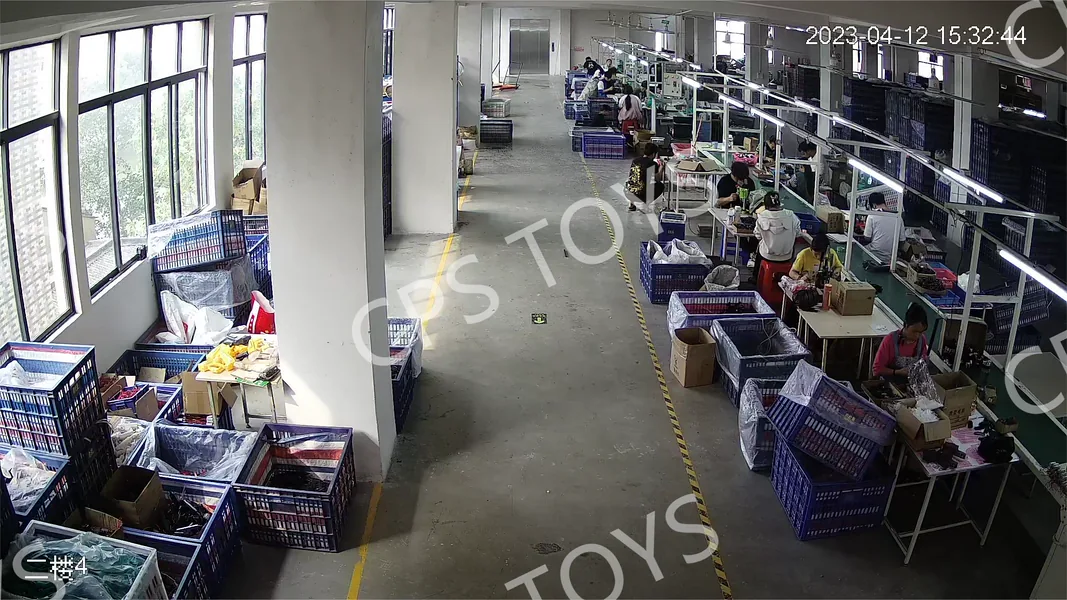
Start on the injection molding floor. Look at the molds running on the machines. Are the cavities visibly polished, or do you see rough EDM marks? Rough molds produce sharp flash at the parting line — a defect that manual deburring operators will miss on a percentage of pieces. Ask to see the mold maintenance log. A factory that can't show you a dated log with recorded polishing intervals is running molds past their safe cycle count.
Watch the trimming station. For plush or fabric toys, the cutting dies and scissors should be sharp enough to produce clean, radiused fabric edges. Frayed edges on plush seams indicate dull tooling, which also creates loose threads that detach and become small parts. Check the lighting at the trimming bench. Poorly lit workstations hide burrs and sharp edges from the operator trimming them.
How Do I Run a Destructive Sample Test During a Factory Visit?
Pull 20 random samples from the production line — not from a sealed 'golden sample' box the factory prepared. Spend 10 minutes destroying them. Twist, drop from 1 meter onto concrete, and pry at any attached components with reasonable force. If any component breaks off and fits inside a 35mm film canister (a reasonable proxy for a small parts cylinder), flag the entire lot. Document every failure with your phone camera, including the batch code on the carton. This photographic evidence is your leverage in any rework negotiation.
How Do I Verify a Supplier's Test Report Is Legitimate?
A supplier who hands you an EN71 or ASTM F963 certificate without hesitation is baseline competent. The real vetting happens in the details. Open the report and check: does the SKU number match your exact PO line item, including color variant? Is the test date within 12 months? Most critically — does the lab hold ISO 17025 accreditation, and can you verify the certificate number on the lab's public registry? A certificate from a lab that lost its accreditation six months ago is not valid safety documentation.
Common dodge: the 'similar product' report. A supplier offers a test report for a 10-inch plush bear when you're ordering a 6-inch plush bear with a rattle insert. The report is meaningless — the rattle component introduces a new hard part that must be independently tested for detachment. Insist on a report covering your exact SKU, or factor a third-party test ($300-$800 per SKU) into your landed cost. On a 5,000-unit order at $2.50 FOB, that $500 lab fee adds $0.10 per unit.
MOQ and Cost Trade-offs for Safety-Compliant Under-3 Toys
| Compliance Level | Typical MOQ |
|---|---|
| Supplier-provided test report (existing SKU) | 500-1,000 units (stock product); no tooling cost. Lowest unit price but no design control. |
| OEM with supplier-arranged testing | 1,000-3,000 units; tooling amortization may apply. Moderate unit price; supplier manages the lab submission. |
| Full third-party lab certification per batch | 3,000+ units to absorb per-SKU test fees ($300-$800). Higher landed cost but strongest retailer documentation. |
| Custom mold with safety-first tooling (polished, radiused) | 5,000+ units; mold investment $2,000-$8,000. Highest upfront cost but lowest per-unit defect rate and rework risk. |
What Should I Ask Suppliers Before Committing to a PO?
The right questions, asked before a PO, separate professional buyers from those who learn about compliance through chargebacks. Use this checklist in your RFQ or during a factory visit. Don't accept verbal answers — ask for documented evidence on the spot.
| "Can you provide the EN71-1 or ASTM F963 test report for this exact SKU, dated within the last 12 months?" | Ask for the PDF before the sample ships. Verify the lab's ISO 17025 accreditation on their website. A report for a 'similar' product is a polite refusal — treat it as a no. |
|---|---|
| "What is your internal QA protocol for sharp edges and burrs on the production line?" | Expect a specific answer: 'Our QC operators check 10 pieces per hour against a 2mm radius gauge at the trimming station, and we log results.' Vague answers like 'we have strict quality control' indicate no protocol exists. |
| "How do you secure small components — adhesive, ultrasonic welding, or mechanical fastening? What's the pull-force specification?" | For glued components, ask for the adhesive spec sheet and curing time. For welded parts, ask about the weld parameter log. The correct answer includes a number: 'We test to a 90N pull force on every batch.' |
| "What's your policy if our third-party inspection finds small parts or sharp edges on more than 2% of the sample?" | The answer should be immediate and specific: 'We rework the entire lot at our cost and re-present for inspection within X days.' A supplier who negotiates this on the spot hasn't internalized safety accountability. |
| "Can you ship us a production sample from the actual mold and material, not a hand-made prototype?" | A 'golden sample' hand-finished by an engineer proves nothing about production consistency. A production sample pulled randomly from a pilot run tells you what the factory actually ships. |
FAQ
What's the most common reason under-3 toys fail safety tests?
Detached components during use-and-abuse testing are the top failure mode. Glued-on eyes, poorly sewn accessories, and plastic parts that snap off at thin cross-sections are the usual culprits. These failures are almost always a production consistency problem, not a design flaw.
How much does third-party safety testing cost per SKU?
Full ASTM F963 testing for small parts, sharp edges, and cord length typically runs $300-$800 per SKU at an accredited lab, depending on the toy's complexity and number of materials. Rush service adds 30-50%. Always budget this into your landed cost calculation before negotiating FOB price.
Can I rely on the factory's own test report?
Only if the factory uses an independent, ISO 17025-accredited third-party lab — not an in-house 'testing room.' Verify the lab's accreditation directly on the lab's website. A factory's internal QC data is useful for process monitoring but insufficient for retailer compliance documentation.
What's the minimum MOQ for fully safety-tested under-3 toys?
For existing stock products with current test reports, MOQs can be as low as 500-1,000 units. For OEM products requiring new mold tooling and fresh lab certification, expect MOQs of 3,000-5,000 units to make the testing and tooling amortization viable.
Do cord length rules apply to elastic loops and stretchy strings?
Yes. The 22cm maximum applies to any cord, string, elastic, or ribbon when stretched to its maximum length using a 2kg (EN71) or 2lb (ASTM) pull force. Elastic materials that stretch beyond 22cm fail, even if the relaxed length is shorter. This catches many first-time importers off guard.
Get a Quote for Safety-Tested Under-3 Toys
If you're sourcing toys for children under 3 and need a manufacturing partner with current EN71 and ASTM F963 reports for custom and OEM orders, contact TopToyFactory. Our team in Shantou works with polished, radiused tooling as standard. Send your design brief or target specifications, and we'll return a quote with compliance documentation within 48 hours.